


With billions of people using Facebook and Instagram every day, Meta gives Shopify & ecommerce brands an incredible opportunity to reach new customers and grow sales.
What sets Meta ads apart is their combination of massive reach and precise targeting. You can reach people based on their interests, behaviors, shopping habits, and previous interactions with your brand, making it easier to put the right products in front of the right audience at the right time.
For Shopify stores, Meta ads do far more than generate traffic. They can drive immediate sales, help you build engaged audiences, retarget warm prospects, and use dynamic product ads to show shoppers the exact products they've viewed. Better still, you can scale your campaigns in a controlled, predictable way, allowing your results to grow alongside your business.
However, success doesn't come from simply launching a campaign and hoping for the best. Having a strong strategy is essential, and there are several best practices every ecommerce and Shopify store owner should follow to get the most from their ad spend.
In this guide, we'll walk you through the best practices for targeting audiences with Meta ads so you can improve performance, skyrocket conversions, and grow your store with confidence.
.webp)
1. Know Your Audience
Successful Meta advertising starts with understanding exactly who you’re trying to reach. So take time researching your ideal customers’ demographics, interests, online behaviors, pain points, and buying habits. The more you know about your audience, the easier it is to create ads that feel relevant to them.
Start by building core audiences using factors such as age, location, interests, and behaviors. This helps you reach people who are likely to be interested in your products, whether that’s fitness enthusiasts, fashion lovers, or beauty shoppers.
Next, make the most of custom audiences. These include people who’ve already interacted with your business, such as website visitors, organic social media engagers, or email subscribers. Since they’re already familiar with your brand, they’re more inclined to convert, making them ideal for retargeting campaigns (which we’ll dive into later). This also means you’re focusing your budget on users showing stronger purchase intent.
The key here is rather than relying on assumptions, use previous campaign results to understand who your ideal customers are and what resonates with them.

2. Segment Your Audience
Not every customer is at the same stage of the buying journey, so your ads shouldn’t all deliver the same message. Segment your audience based on how they’ve interacted with your brand to create more relevant campaigns.
One of the best places to start is website visitor retargeting. These people have already shown interest, making them far more valuable than completely new prospects.
You can refine this further by creating dedicated campaigns for visitors who abandoned their cart or started the checkout process, encouraging them to come back and complete their purchase.
And of course, existing customers are another valuable audience segment. Use upsell and cross-sell campaigns to promote complementary products or increase repeat purchases. You can also upload your email list to reconnect with subscribers or other warm contacts through personalized messaging.
It’s simple: the more relevant your ads are to each audience segment, the better they’ll perform. By tailoring your creative and offers to match where someone is in the customer journey, you can improve engagement, and conversion rates, and make your ad spend work harder.

3. Prioritize Personalization
Personalized ads are far more likely to capture attention because they resonate with the person seeing them. Instead of showing the same creative to everyone, tailor your campaigns based on customer interests, browsing behavior, or previous purchases.
Showcasing recently viewed products, recommending complementary items, or using dynamic product ads can remind shoppers why they were interested in the first place. Even small personal touches, such as using a customer’s name where appropriate, can make your Meta ads way more engaging.
Personalization doesn’t just improve the customer experience - it also delivers stronger results. Studies have found that personalized advertising can improve ROI and campaign efficiency by up to 30%. It’s also something consumers increasingly expect, with 81% of Gen Z and 57% of Millennials saying they prefer personalized ads.
By using the customer data available through Meta and Shopify, you can create campaigns that feel timely, useful, and far more effective than generic advertising.
.webp)
4. Use Lookalike Audiences
Lookalike Audiences are one of Meta’s most effective tools for reaching new customers who share similar characteristics with your existing buyers. By using your customer data as a foundation, Meta can identify patterns and find people who are likely to be interested in your products, helping you expand your reach without sacrificing relevance.
The quality of your source audience plays a major role in performance. Start with a strong seed audience, such as past customers, as these users provide Meta with valuable data on what your best buyers have in common.
For even better results, consider using high customer lifetime value (LTV) customers, as this helps Meta find people who are more likely to purchase and become long-term customers.
You can also create Lookalike Audiences from other valuable groups, including email and push notification subscribers, or people who’ve interacted with your ads and content in the past. These audiences already show interest in your brand, making them useful starting points for finding similar prospects.
Once your core campaigns are generating consistent results, Lookalike Audiences can help you scale beyond your existing traffic. They allow you to reach new potential customers while maintaining a level of targeting accuracy, so you can grow your campaigns without causing performance to drop.

5. Run Retargeting Campaigns
Retargeting allows you to reconnect with people who’ve already shown interest in your brand but haven’t completed a purchase. These audiences are often more valuable than cold traffic because they’re already familiar with your products and may only need an extra reminder or incentive to convert.
For example, someone who viewed a product page may respond well to an ad highlighting that product again, while an abandoned cart shopper may need a reminder, review, or offer to encourage them to return.
Retargeting is one of the most effective ways to turn existing interest into sales. In fact, customers are up to 70% more likely to purchase a product when they’re retargeted with display ads, making it an essential part of any Meta strategy.
By showing relevant ads at the right stage of the buying journey, you can recover missed revenue opportunities and get more value from the traffic you've already paid to generate.

6. Use High-Converting Ad Formats
The format you choose can have a major impact on how people engage with your Meta ads. Different ad types appeal to different audiences and stages of the buying journey, so testing a variety of formats can help you identify what brings the best results for your Shopify store.
Video ads, user-generated content (UGC), influencer collaborations, carousel ads, collection ads, and dynamic product ads are all examples of high-converting formats.
Video content is especially effective for capturing attention and showcasing your products in action, with 67.55% of Facebook advertisers reporting that videos get more clicks than other ad content types. Reels can be particularly powerful, with 79% of users saying they’ve purchased a product after watching a Reel.
UGC-style ads, such as unboxings, testimonials, and customer reviews, are also highly effective because they build trust and provide social proof. With 95% of consumers reading online reviews before making purchase decisions, authentic content from real customers can help remove any hesitation and get potential buyers excited about your products.
For Shopify and ecommerce brands, carousel ads are useful for highlighting multiple products or features, while collection ads create a more immersive storefront experience. Dynamic product ads are ideal for retargeting because they automatically pull products shoppers are most likely to be drawn to.
The goal is to match the right format with the right customer. When your ad showcases exactly what someone is looking for, it feels more relevant, less intrusive, and more likely to bring in clicks and conversions.

7. Set Clear Campaign Objectives
It’s so important for every Meta ad campaign to start with a clear goal. Whether you’re looking to…
- grow Shopify & ecommerce sales,
- generate leads,
- get more website traffic,
- boost engagement,
- retain customers,
- or build trust & brand awareness
…defining your objective helps Meta understand what action you want users to take.
Your campaign objective directly influences how Meta’s algorithm delivers your ads. The platform uses this information to find people who are more inclined to complete your desired action, whether that’s clicking a link, immediately making a purchase, or interacting with your content.
For example, sales campaigns are designed to reach people who are most likely to buy, while traffic campaigns can help introduce your products to new potential customers. Other objectives, such as engagement and retention campaigns, can help you reconnect with high-intent consumers who’ve already shown interest in your brand.
Choosing the right campaign objectives ensures your budget is working toward a specific outcome rather than simply generating meaningless activity. A well-defined goal gives Meta the right signals to optimize your campaigns, making it easier to measure performance, improve results, and scale effectively.

8. Pick the Right Products, Offers, and Promotions
The products you put in front of your audience can make or break your ad performance, so it’s important to start with items that already have a strong chance of converting.
Bestsellers, high-margin products, and items with plenty of positive reviews are usually the safest choices because they already have proof that customers want them and bring value to their lives.
Instead of trying to create demand from scratch, you’re using your ads to amplify products that are already generating interest.
The right offer can make your ads even more compelling. Bundles can encourage shoppers to purchase more items and increase average order value (AOV), while limited-time discounts create a sense of urgency and FOMO, giving customers a reason to shop before it's too late. The key is to make your offers and promotions feel valuable rather than overly sales-focused.
Timing matters too. Seasonal and event-based campaigns should connect cohesively with what your customers are already looking for. Consider aligning your ad promotions with holidays, gifting moments, major shopping events, trends, or customer behaviors, such as back-to-school shopping or Shopify Black Friday Cyber Monday campaigns.
When your products, offers, and timings are all aligned, your ads are set to connect with people at the exact moment they’re ready to buy. Instead of simply promoting a product, you’re giving shoppers a relevant reason to click, whether that’s discovering a bestseller, taking advantage of a limited-time offer, or finding the right product for their needs.

9. Set The Right Budget & Scale Strategically
Getting your budget right from the start gives your Meta campaigns the best chance of success without wasting ad spend. Begin with a budget that feels realistic for your business and goals, then give your campaigns enough time to collect meaningful data before scaling further.
Understanding where your budget goes is just as important as how much you spend. Campaign budgets control the overall amount allocated to a campaign, while ad set budgets allow you to control spending across different audiences, placements, or targeting strategies. Knowing the difference helps you make smarter decisions about where your money is being invested.
Timing can also impact performance. Test different days and times to understand when your audience is active and most likely to convert. Once you have enough data, you can adjust your schedule and focus your budget on the periods that deliver the strongest results.
When a campaign consistently performs well, gradually increase your spend rather than making large budget changes too quickly. Scaling successfully isn’t about simply spending more, but about putting more budget behind strategies that are already working.
With the right approach, your campaigns become easier to manage, more predictable, and better positioned for long-term ecommerce and Shopify growth.

10. Track The Right Metrics
The success of your Meta ads depends on more than just clicks and sales - it comes from understanding which metrics are actually contributing to growth and using that data to make better marketing decisions.
By monitoring the right KPIs instead of just vanity metrics, you can identify opportunities to optimize your campaigns, improve efficiency, and maximize your return on ad spend (ROAS).
Some of the key metrics to focus on include:
- ROAS (Return on Ad Spend): Shows how much revenue you generate for every dollar spent on advertising, making it one of the clearest indicators of campaign profitability.
- ROI (Return on Investment): Shows the percentage of people who click your ad after seeing it, helping you understand how effective your creative and messaging are at capturing attention.
- CPC (Cost Per Click): Measures how much you pay for each click, meaning you can evaluate ad costs and manage your budget efficiently.
- CPA (Cost Per Action): Shows the cost of getting someone to complete a specific action, such as making a purchase, signing up, or submitting a form.
- Conversion Rate: Measures the percentage of people who click your ad and complete your desired action, so you can better understand how effectively your store turns traffic into customers.
To improve performance over time, use A/B testing to experiment with different headlines, visuals, offers, and calls-to-action (CTAs). Then pause ads that consistently underperform on these key metrics and increase spend on the Meta ad campaigns that deliver strong results.

11. Continuously Test & Optimize
One of the best practices for targeting audiences with Meta ads is to never assume you’ve found the perfect campaign and you don’t have to do any more work. Audience preferences, shopping behaviors, and market trends change over time, so ongoing testing is essential to keep your ads performing at their best.
Regularly experiment with different audiences, formats, creatives, offers, headlines, ad copy, placements and CTAs to see what resonates most with your target customers. Even small changes can have a noticeable impact on click-through rates, conversions, and ROAS.
As you collect more data, use those insights to refine your campaigns. Scale the ads that are consistently high-converting, pause underperforming variations, and continue testing new ideas to uncover additional opportunities for growth.
The best performing Meta campaigns are rarely perfect from day one. They become more effective through continuous optimization, informed by real performance data rather than guesswork. By making testing an ongoing part of your strategy, you’ll improve targeting, maximise your budget, and achieve more sustainable Shopify growth over time.
Tips From Our Meta Ads Experts at StoreLab
Brand Building
"The strongest Meta performance comes from brands that balance short-term conversions with long-term brand building.
Creative that builds trust and memorability does more than just lift brand metrics. It stabilises CPAs, reduces fatigue, and drives more efficient growth over time for our Shopify clients." - Harrison, Performance Marketing Specialist
Consistency
“What I’ve seen across my clients is that consistency really compounds over time. When campaigns run steadily, it gives the Meta algorithm the space it needs to learn and allows the funnel to properly fill.
When clients stay consistent with both their campaign budgets and content supply, that’s when Meta finally has the signals it needs to start delivering real results. It’s the clients who buy into the journey (not just the destination!) who end up seeing the best outcomes.” - Tom, Account Management Team
Authenticity
“Authentic content performs so well on Meta because people can instantly tell when something feels real.
Ads that look and feel like the content they’re already engaging with tend to build trust faster, stop the scroll more often, and usually outperform overly polished creatives. At the end of the day, people connect with real people.” - Lea, Account Management Team
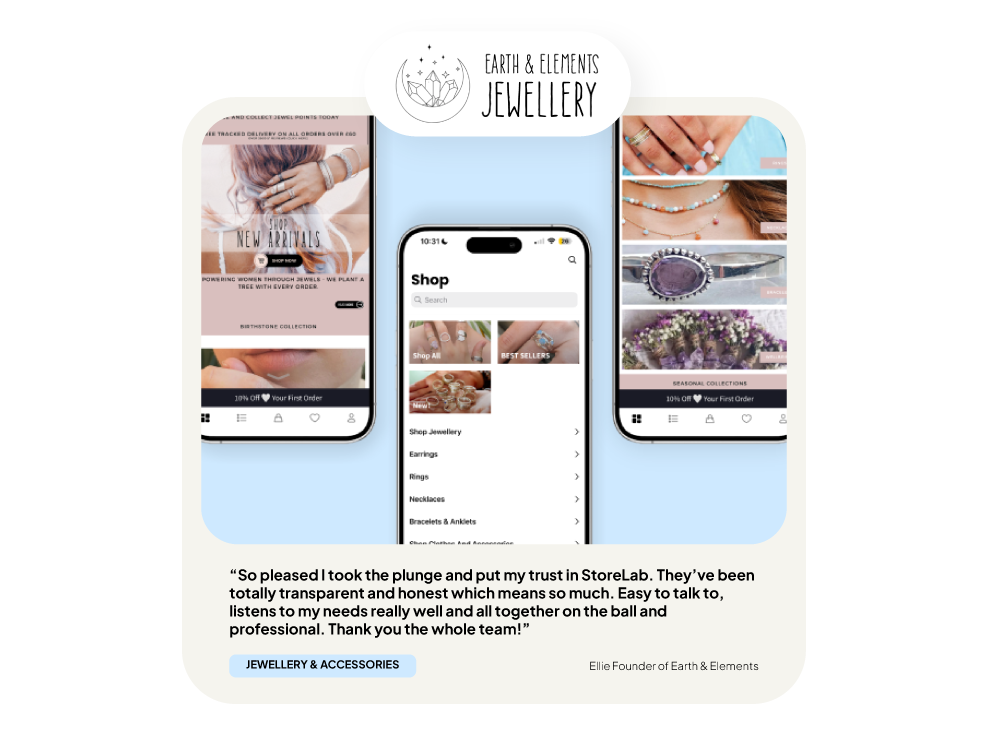
Success Story: Earth & Elements Jewelry - +245% Sales Through Targeted Meta Ads
About Earth & Elements Jewellery
Founded in 2018, Earth & Elements Jewellery began when owner Ellie left her 10-year career in microbiology to pursue her passion for spiritual growth, crystal healing, and wellness.
What started as a successful Etsy crystal jewellery business has since evolved into a conscious lifestyle brand, rooted in sustainability and dedicated to responsibly sourced well-being products.
Why Earth & Elements Partnered with StoreLab
Ellie began actively seeking a trustworthy, growth-focused agency or partner who could improve her online positioning to boost traffic and drive more sales for her Shopify store.
The partnership began with a full edit of her online presence, identifying gaps in both her social media visibility and ad performance.
The solution? Launching targeted paid social campaigns to strengthen brand visibility and increase conversions.
Results & Evidence of Success
- Earth & Elements’ Meta ad campaigns were able to boost brand engagement and drive sales by +245% in the first 90 days.
- The ads had a really positive start, achieving over a 3x ROAS (Return on Ad Spend) and growing to over 7x ROAS within 3 months of launch.
- The total value of purchases doubled over the course of just one month.
- Earth & Elements saw a 173.96% ROI in just three months.
- With a lifetime ROAS of 3.94x, the brand earned nearly £4 for every £1 spent.
Read the full case study here.
Want to see success for your Shopify store like Earth & Elements did? Learn more about our Meta ads service at StoreLab.
Looking For Guidance on Seeing More Sustainable Shopify Growth?
If you're looking to grow your Shopify store in 2026, partnering with our team at StoreLab can help you scale with confidence. We combine expert strategy with data-driven insights to create sustainable growth, giving you tailored recommendations that deliver measurable results.
Our proprietary CAR Framework is built around the three metrics that matter most:
- Conversion Rate: The percentage of visitors who make a purchase.
- Average Order Value (AOV): How much customers spend per order.
- Returning Customer Rate: The percentage of customers who come back to buy again.
By focusing on these key growth levers, we uncover opportunities to improve performance and build a sustainable revenue engine. Our team combines performance marketing with high-converting Shopify design to help you maximize every stage of the customer journey.
From paid ads and CRO to website design, email marketing, UGC, AI creative, branding, retention strategies, and mobile apps, StoreLab provides everything you need to grow your Shopify store.
Ready to accelerate your growth? Book a call with our team today to discover how we can help you increase sales and build a more profitable Shopify business.

Skyrocket your Shopify sales with a no-code Apple & Android mobile app. Available now on the Shopify app store.







.webp)

